

Blog
The Documentation Needed for Cybersecurity Audits
Preparing for a cybersecurity audit is a big job. It can feel especially overwhelming if it’s your organization’s first time going through an audit. Businesses must understand that a cyber audit isn’t just about technical security controls like firewalls, encryption, and antivirus software. Auditors will be just as focused on documentation. This is true for any security framework an organization wants to demonstrate compliance with, including SOC 2, NIST, CMMC, FedRAMP, and more.
Documentation tells the story of how your organization manages cybersecurity risks, protects systems, and responds to threats. Strong documentation can be the difference between a smooth audit and a stressful one.
In this blog, we’ll explore the key documentation needed for cybersecurity audits.
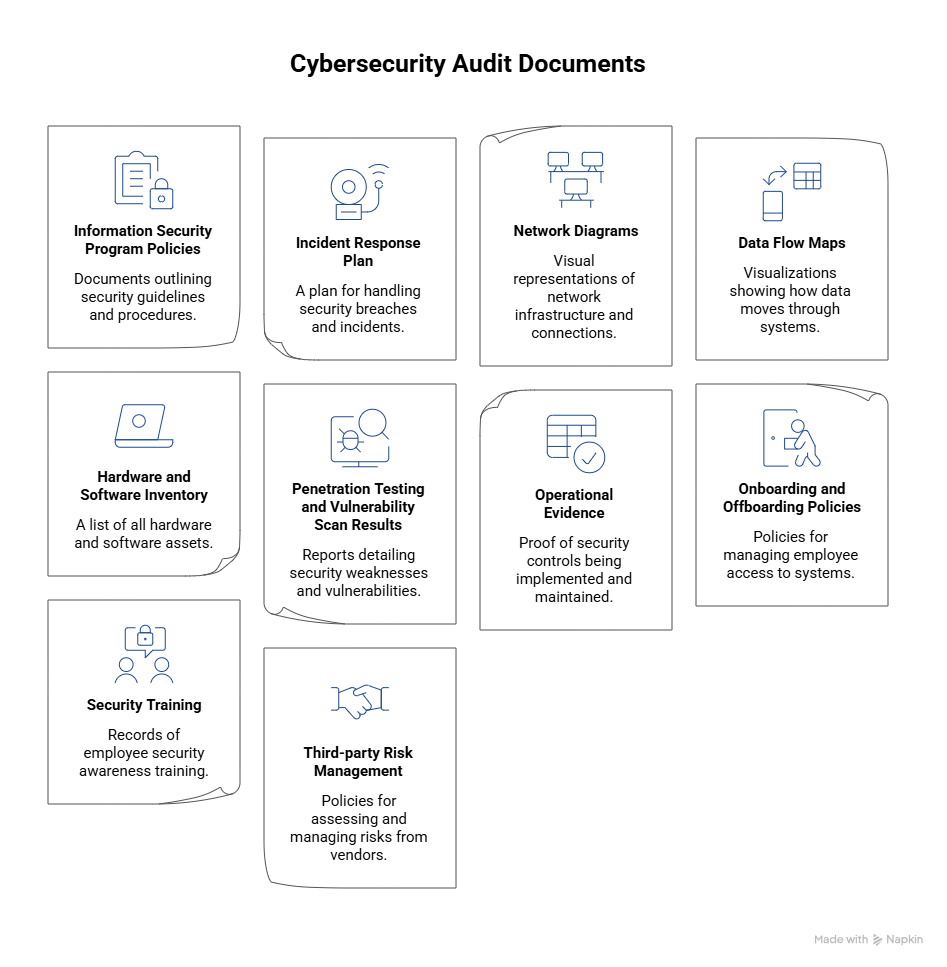
Information Security Program Policies
Information Security Program Policies outline an organization’s requirements for protecting data, assets, and systems to ensure confidentiality, integrity, and availability. Key policy elements of an Information Security Program can include:
- Roles and Responsibilities: Document who is responsible for specific security tasks.
- Data Classification and Handling: Categorizes data (public, confidential, etc.) and outlines how it is securely stored, transferred, and destroyed.
- Access Control and Identity Management: Defines who can access what systems and data.
- Acceptable Use Policy: Outlines what actions are allowed and prohibited for company assets, including internet, email, and social media usage.
- Physical Security Controls: Specifies protections for physical assets, such as office access, device locking, and visitor policies.
- Password Policy: Requirements for password length and complexity, password rotation timelines, and multi-factor authentication.
- Remote Work Policy: Outline how the organization accounts for risks from employees working remotely, including VPN requirements, rules for personal devices, and guidance on working in public spaces.
- Risk Management: Describes how the organization identifies, assesses, and manages risk to information assets, business operations, and data.
- Network Security: Defines the acceptable use of network resources and outlines requirements for protecting network infrastructure from threats (such as unauthorized access, data exfiltration, and denial of service), while supporting business continuity.
Incident Response Plan
A comprehensive incident response plan includes actionable procedures for detecting, analyzing, containing, eradicating, and recovering from security incidents. An Incident Response Team contact list should be included.
Network Diagrams
A network diagram is a visual representation of an organization’s IT infrastructure, mapping the connections between devices, servers, firewalls, and subnets. It’s a blueprint for security teams to identify vulnerabilities, monitor data flows, and plan defenses by showing both physical layouts and logical segmentation.
Data Flow Maps
A data flow map shows how sensitive data moves through an organization’s systems, from entry and storage to processing and exit. It identifies risks and helps secure data in transit and at rest.
Hardware and Software Inventory
You’ll need to provide your auditor with an up-to-date inventory of your hardware and software that includes:
- Servers
- Laptops, desktops, and smartphones
- Endpoint devices
- Network devices
- Installed applications and software
Device identifiers, such as serial numbers and model information, need to be included along with location and device ownership.
Penetration Testing and Vulnerability Scan Results
Include results from any penetration tests or vulnerability scans that were performed. Include information on the status of remediation efforts.
Operational Evidence
Auditors will need to see documentation that proves your security controls are functioning properly. These typically include:
- User access logs
- Change management logs
- Patch management evidence
- Reviews of security events and audit logs
- Recent risk or compliance assessment reports (internal or third party attested)
Onboarding and Offboarding Policies
These documents detail how a business handles account creation, security training, and role-based access when a new employee is hired. They also include procedures for disabling accounts, removing access, and collecting devices when an employee departs.
Security Training
An audit requires documented evidence that all employees have received, understood, and completed security awareness training designed to reduce risks from human error. Required information includes training logs, completion certificates, and curriculum specifics (social engineering/phishing, passwords, data handling, physical security, etc.).
Third-party Risk Management
If your business relies on vendors, cloud providers, and external service partners, auditors will examine how third-party risks are managed. You need to have documentation that demonstrates how you assess vendor risk, including questionnaires and risk scoring methods and results. Also, be prepared to show that your vendor contracts include data protection responsibilities, breach notification expectations, and security requirements.
CompliancePoint has a team of experienced professionals that can help your organization improve its cybersecurity posture and prepare for the audits required to demonstrate compliance with a variety of frameworks. Contact us at connect@compliancepoint.com to learn more about our services.
Finding a credible expert with the appropriate background, expertise, and credentials can be difficult. CompliancePoint is here to help.